We began with a pre-dive briefing. Cora had reviewed the manual and was familiar with the types of searches described there. I usually had students search for a tire to recover since the tire was large and
there were many of them scattered along the Fort Lauderdale beaches. On a prior dive on the Swiss Cheese Reef, however, I had spotted a small but heavy concrete piece with an eyelet in its center. I showed a picture to Cora and instructed her to find this piece along the Swiss Cheese Reef.
We discussed the type of search pattern that might be used and which one would be most efficient. At first, she suggested an expanding square pattern, but instead of a point, we had a line to search. We agreed that having the five of us swim north on the West side of the reef shelf would be the most efficient method to use. We next worked on tying a Bolan knot to attach the lift bag to the weight. Then we geared up and got in the water.
Because Martha is having trouble with her back, I carry her gear to the water for her and carry it back after the dive. Sometimes it takes me a little longer than others to make the trip first with her gear, then with mine. Nonetheless, we managed. We swam to the buoy line and descended at 8:01 am.
We swam East to the Wrap Around Ledge and continued swimming East over the ledge and across the rubble to the Rock Line and then to the Crescent Moon Rock. changed direction from East to NE to the Giant Barrel Sponges and then to the Staghorn Coral. Went East across the coral to the Sectioned Rock and then North along the Swiss Cheese Reef.
Cora spotted the weight after about 15 minutes. She tied to lift the weight, but could not. She tied a Bolan on the eye hook and then tied the lift bag to that line which was a little more difficult because I deliberately used different diameter lines. I filled the lift bag with air from my regulator. The 50-pound lift bag lifted the weight nicely. Cora put a line on the weight and pulled it along near the surface while we swam along the bottom West to the beach. CS carried the weight out of the water and I struggled to carry it to the truck. I dropped my gear and walked back to help Martha get her gear out of the water and back to the truck.
Bottom time was 50 minutes at a maximum depth of 19.0 feet. My SAC was 16.80 psi/minute and the RMV was .43 ft3/minute.

A continuing log of dives and commentary on items of interest to students at Cordova Diving.


25 August 2019
Sunday, 25 August 2019 Navigation Dive off Tower 4
Martha was tired and elected to stay on the beach. CS and Acacia wanted to find a hardware store to repair Cora's fins. Cora borrowed CS's fins and she and I went out to make a navigation dive.
We swam out to the buoy to descend at 10:14 am, swam over the Wrap Around Ledge and headed to the rock line. We were swimming East when it occurred to me that this was an ideal sand flat to use. So we stopped and set up.
I remained in one place with the flag and Cora swam 30 kick cycles on a 100-degree bearing, then returned on the reciprocal bearing. Thirty kick cycles is about 20 yards, so I left the flag in place and followed her at a distance. I got back to the flag in time for her to find me. She was less than 2 feet off the mark.
Her square was not as tight as it might have been, but she nonetheless found me in the limited visibility. She was within 5 yards. I congratulated her and we swam over the staghorn coral again before heading back to the beach.
Our bottom time was 52 minutes at a maximum depth of 18.3 feet, which was pretty good considering I did not change to a new tank but rather used the same tank I used on the first dive. My SAC was 13.7 psi/minute and the RMV was .35 ft3/minute. Good dive all around.
Sunday, 25 August 2019 Buoyancy Dive off Tower 4
At 6:30 am, Martha and I drove to the Ocean Parking Lot on South A1A and the Mos were just moments behind us. Gearing up was a little chaotic, but we got it done and were on our way to the beach by 7:25 am. I was carrying the hoola hoops. We descended at the buoy line at 7:42 am and headed East to the Wrap Around Ledge. I had planned to get on the sand before the staghorn coral, but decided it was problem enough to carry the hoops to the Ledge.
I set the Hoola Hoops up and took Cora aside. I did not test for buoyancy because we had just guessed at the 8 pounds she carried and I am certain she was heavy. We did make a very slow controlled descent and then spent time hovering and moving from one depth to another by just changing our breathing. Then we went through the hoops.
I lead and Cora followed. I went through the bottom hoop on the West; swam up to the bottom hoop on the East and floated up to pass through the top hoop using only my breathing to change depth. I went back and forth floating to different depths and swimming from one set of hoops to the other. Cora followed. Once the pattern was established, I stepped back and watched as Cora went from one hoop to another. She did very well, so I went through on my back and she followed, moving slowly and carefully controlling her depth. She was moving a little too fast, but she had good control of her position in the water.
We joined the others and headed to the Staghorn Coral then North along the Swiss Cheese Reef to the first Coral Head on the upper shelf. I turned the dive there and we swam back to the beach, picking up the hoops at the Wrap Around Ledge. No one was out of air. and no one complained of being too heavy or light.
Bottom time for the dive was 69 minutes at a maximum depth of 18.4 feet. My SAC was 17.99 psi/minute and my RMV was 0.46 ft3/minute.
18 August 2019
Sunday, 18 August 2019, 4th Open Water Dive
During our almost 2-hour surface interval, Andreina took her final exam for the second time. This time she passed missing only 3 questions.
On that happy note, we geared up and got in the water. We swam out past the buoy line and descended where I hoped to find the blocks, but they were not there. We headed East looking for landmarks.
I photographed a Spotted Trunkfish after about 15 minutes.
I saw a small Green Sea Turtle about 5 minutes after seeing the Trunkfish. She looked like she was just waking up. .
She glanced over at me and then raced away. I didn't even try to keep pace with her.
As we continued swimming across the Big Coral Knoll, we came upon a much larger Green Sea Turtle who was also just waking up.
This turtle swam slowly right next to me as the Andreina and Evan caught up with us. She seemed quite happy to swim along with us.
I got this great closeup of the turtle as Evan came towards us. She did not seem threated by me or the camera. I had no strobe.
I got this great shot of Even directly in back of the turtle as we swam along the Big Coral Knoll.
These two Green Sea Turtles were the star of the dive, but there were a lot of other fish to see.
This Gray Angelfish, for instance, swam with us for a short while and seemed unafraid of us.
These Ballyhoo seem to hang in the first few feet from the surface and travel in larger schools.
Bottom time was 86 minutes at a maximum depth of 20.4 feet. My Surface Air Consumption rate was 16.02 psi/minute and the Residual Minute Volume was 0.41 cubic feet/minute.
On that happy note, we geared up and got in the water. We swam out past the buoy line and descended where I hoped to find the blocks, but they were not there. We headed East looking for landmarks.
 |
| Spotted Trunkfish (Lactophrys bicaudalis) |
I photographed a Spotted Trunkfish after about 15 minutes.
 |
| Green Sea Turtle (Chelonia mydas) |
I saw a small Green Sea Turtle about 5 minutes after seeing the Trunkfish. She looked like she was just waking up. .
 |
| Green Sea Turtle (Chelonia mydas) |
She glanced over at me and then raced away. I didn't even try to keep pace with her.
 |
| Green Sea Turtle (Chelonia mydas) |
As we continued swimming across the Big Coral Knoll, we came upon a much larger Green Sea Turtle who was also just waking up.
 |
| Green Sea Turtle (Chelonia mydas) |
This turtle swam slowly right next to me as the Andreina and Evan caught up with us. She seemed quite happy to swim along with us.
 |
| Green Sea Turtle (Chelonia mydas) |
I got this great closeup of the turtle as Evan came towards us. She did not seem threated by me or the camera. I had no strobe.
 |
| Green Sea Turtle (Chelonia mydas) |
I got this great shot of Even directly in back of the turtle as we swam along the Big Coral Knoll.
These two Green Sea Turtles were the star of the dive, but there were a lot of other fish to see.
 |
| Gray Angelfish (Pomacanthus arcuatus) |
This Gray Angelfish, for instance, swam with us for a short while and seemed unafraid of us.
 |
| Ballyhoo (Hemiramphus brasiliensis) |
These Ballyhoo seem to hang in the first few feet from the surface and travel in larger schools.
Bottom time was 86 minutes at a maximum depth of 20.4 feet. My Surface Air Consumption rate was 16.02 psi/minute and the Residual Minute Volume was 0.41 cubic feet/minute.
Sunday, 18 August 2019 3rd Open Water Dive off Tower 17
 Andreina Gomez began the PADI Open Water Certification class on 14 May 2019. She attended classes on the 15th and 19th of May which was when she had scheduled her pool session. We discussed Chapters 4 and 5 in the Manual and she took but failed her final examination on that date. She did successfully completed her pool session, however. She completed her first two Open Water dives on June 2nd, but suffered a panic attack on one of those dives which kept her from diving again until today.

Both Evan and Andreina insisted that 10 pounds would be too heavy for them, so we went with 8 pounds, each. We got in the water at 7:30 am and swam on the surface out to the Eastern Edge of the First Reef line to make the two ascents required for Andreina's certification. I towed Andreina a good part of the way because without assistance she would drift off to the North.
When we got to the Ledge, I went below to tie off the flag line. I expected Evan and Andreina to descend along the flag line when I signaled them by pulling the flag sharply twice in a row. I watched Evan approach the flag and I signaled and I waited but no one showed up. I was concerned that they may have had some trouble descending, but I surfaced and there was no one at the surface near the flag. A long 5 minutes later I spotted Evan and yelled to get his attention. They were together, but they had drifted about 100 yards to the North.
They swam back to the flag and I explained that in low visibility environments like what we experienced that day, divers should follow the flag line down to ensure they would not drift away. Andreina descended slowly but seemed to have no trouble clearing her ears. Once she got to the bottom we quickly made the alternate air source ascent.
Then we tried the CESA. I had explained that I wanted to take and exhale two complete breaths then take out the regulator and ascend once we had inhaled the third breath. She aborted the first attempt within seconds of starting the ascent. I went through the explanation a second time with hand signals. Our next ascent was fine. We went up slowly and controlled. She continuously exhaled all the way to the surface.
We made a final descent to untie the flag line and then swam underwater back to the beach. I had hoped to find the Big Coral Knoll along the way, but we did not. Still, no one ran out of air. They were light, however, as they ran out of air. I gave them each rocks to hold and to make them neutrally buoyant.
Our bottom time
was 55 minutes with a maximum depth of 35.5 feet. My SAC was 17.46 psi/min and the RMV was .45 ft3/min.
28 July 2019
Sunday, 28 July 2019 Solo Dive on the Swiss Cheese Reef

 |
| Yellowline Arrow Crab (Stenorhynchus seticornis) |
 |
| Porkfish (Anisotremus virginicus) |
I went North to the Tire and then headed East to the Crescent Moon Rock. I shifted a little North to find the Staghorn Coral and East to the Sectioned Rock.
 |
| Bluestriped Grunt (Haemulon sciurus) |
Started having some problems with the camera. Couldn't change the aperture. The mount on the camera had come loose and the camera was not well mounted to the housing so the arms and switches on the housing no longer changed the camera settings. I still took some shots and most of them came out okay after editing, but they looked washed out on the camera's screen.
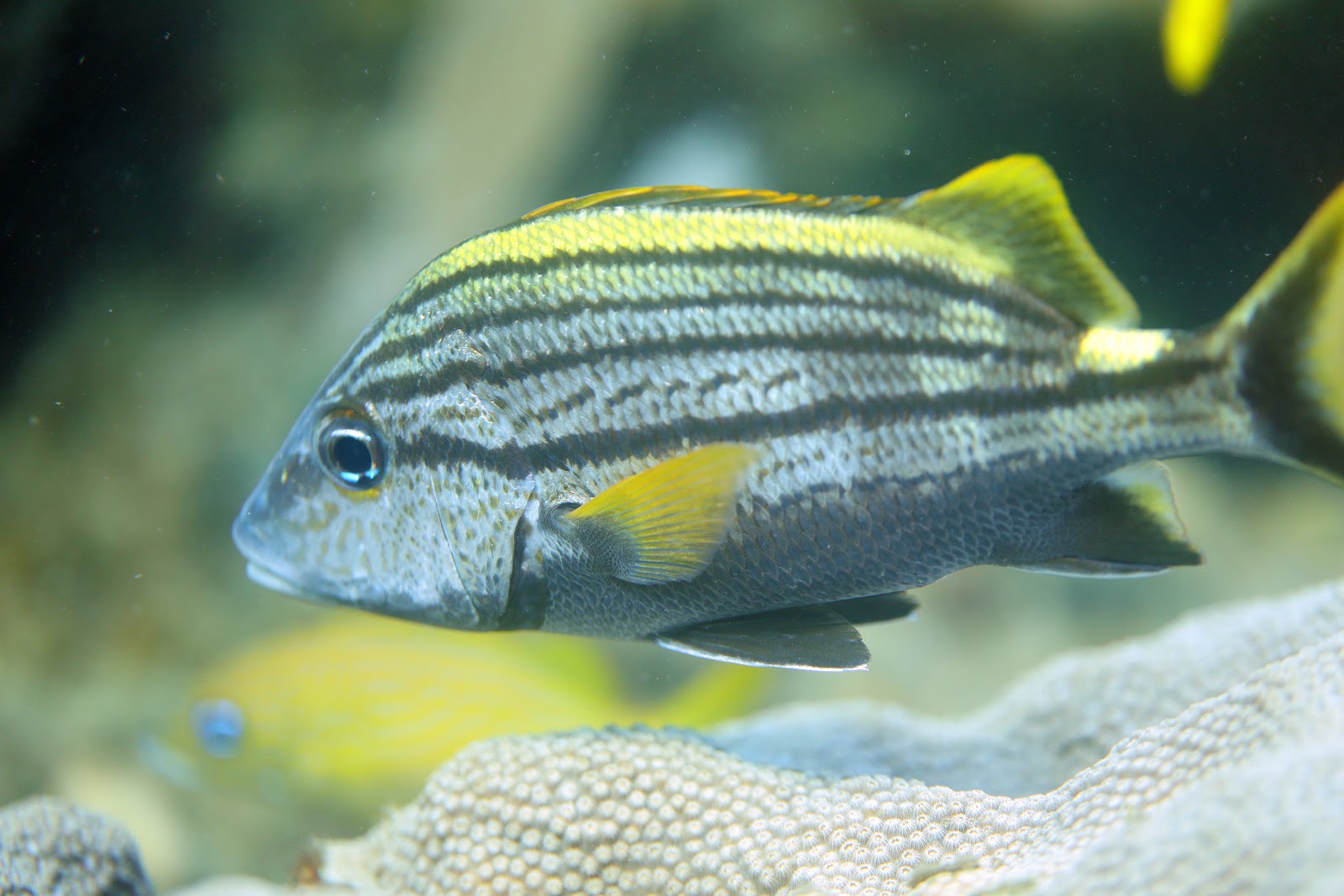 |
| Spanish Grunt (Haemulon macrostomum) |
 |
| Smallmouth Grunt (Haemulon chrysargyreum) |
 |
| Caesar Grunt (Haemulon carbonarium) |
 |
| Orange Spotted Filefish (Cantherhines pullus) |
 |
| Honeycomb Cowfish (Acanthostracion polygonius) |
 |
| Sharpnose Puffer (Canthigaster rostrata) |
I probably could have squeezed another 10 minutes out of the tank, but I was concerned about the lifeguards and how quickly I could walk out of the ocean and back to the truck without triggering a reaction from them. I decided not to push my luck.
 |
| Spotted Goatfish (Pseudupeneus maculatus) |
I surfaced inside the buoy line with a 140 minute bottom time at a maximum depth of 20.2 feet. My Suunto computer calculated my SAC at 14.54 psi/min and the RMV at 0.33 cubic foot/minute.
23 July 2019
Tuesday 23 July 2019 Martha and I dive the Fish Camp Rocks
 Martha and I drove to our spot behind Tower 17 and geared up. We wound around some fishermen to get in the water without tangling ourselves in their fishing line. We swam out looking for the blocks and found them. I tried to establish an intersecting line but failed to take a picture, so I'm not sure that I will be able to find it again. Still, we started our dive at the blocks. Went up the gun sight to Irish thighs then the Cigar Rock and finally to the Gray Mid-Way Rock.

Got some pictures of a small school of Atlantic Spadefish, a number of grunts, Snappers and other common fish. We swam to the Big Coral Knoll, but there were no turtles there and not a lot of fish, either.

a French Grunt (Haemulon flavolineatum)


A Bluestriped Grunt (Haemulon sciurus);

A Gray Snapper (Lutjanus griseus)

A Spanish Grunt (Haemulon macrostomum);

A Schoolmaster (Lutjanus apodus);

We went looking for the smaller knoll to the NE, but I turned back without finding it. We headed back to the Fish Camp Rocks and then headed West to the beach.
Bottom time was 130 minutes, our maximum depth was 19.2 ft. My SAC was 14.41 psi/minute and an RMV of 0.37 cubic feet per minute.
Tuesday, 23 July 2019 4th Open Water Dive on the Fish Camp Rocks

During our surface interval, Johnny got lunch and we discussed the 6 table problems. He took and passed the table quiz and the table final. This was his 4th open water dive. We geared up using the same tanks we used on our first dive. Johnny had used my air on the alternate air source ascent, so we both had 1600 psi left. We swam on the surface past the buoy line and descended.
 |
| Schoolmaster (Lutjanus apodus) |
I headed due East hoping to catch sight of the Big Coral Knoll, which I did. Not much life on the knoll, however, so we headed South to the Fish Camp Rocks, where we saw lots of French, Smallmouth, Bluestriped and Spanish Grunts as well as various parrotfish and Some Schoolmasters.
 |
| French Grunt (Haemulon flavolineatum) |
 |
| Spanish Grunt (Haemulon macrostomum) |
 |
| Bluestriped Grunt (Haemulon sciurus) |
 |
| Gray Snapper (Lutjanus griseus) |
 |
| Initial Phase Redband Parrotfish (Sparisoma aurofrenatum) |
Johnny signaled that he was down to 800 psi, so I turned the dive and we headed for the beach. Johnny carried 8 pounds but was light. He had to swim to stay down and was blowing through a lot of air.
 |
| Spotted Goatfish (Pseudupeneus maculatus) |
I signaled that he should use my alternate air source, which he did. He hung on my BCD and I picked up a rock to assist with our buoyancy. He was high and to my right, so we could each kick unimpeded. I watched my gas pressure fall to less than 200 psi as we got to the buoy line.
 |
| Hogfish (Lachnolaimus maximus) |
I signaled that we should surface and we did. We then swam to the beach on the surface.
Bottom time was 42 minutes with a maximum depth of 210.2 feet. My SAC was 23.34 psi/min and my RMV was 0.6 ft3/min, though those numbers were inflated by Johnny breathing on my tank for the last 5 - 10 minutes of the dive.
Tuesday, 23 July 2019 3rd Open Water Dive Off Tower 17
Johnny met me on A1A behind Tower 17 at 7:00 am. It did not take long to gear up, but we had a 25-minute surface swim to get to the Eastern Ledge of the First Reef line. When we got to the Ledge, I went down to secure the flag line, which I did by wrapping the line across a flat bit of rock and catching it under a rock lip at the ends. Johnny came down slowly and kept his ears equalized.
On the bottom, I indicated that he should signal that he was out of air and needed to share air, that he should hold the strap on my BCD, and that he should use his breathing to control his buoyancy. He signaled as he should and took my alternate air source. He also grabbed onto my BCD strap. Unfortunately, we went nowhere for the first 2 minutes then we swam to the surface. He simply could not use his breathing to become positively buoyant. The total time for the ascent was almost three minutes.
At the surface, I let him know that we needed to increase our ascent speed for the CESA. I signaled that he should watch me as I took 2 deep breaths in and out then took a deep breath in and dropped my regulator's second stage. He did fine except that he thought we were going up and I needed to settle him back on the sand. When we did swim up, we did so in under 35 seconds from 32 feet, which was perfect. I went back down and freed the flag line and Johnny met me at about 20 feet and we swam back to the beach.
Bottom time was 44 minutes, including the ascents; maximum depth was 31.9 feet; my SAC was 19.02 psi/min and my RMV was 0.49 ft3/min somewhat distorted by Johnny's breathing with me on the alternate air source ascent.
22 July 2019
Monday, 22 July 2019 Solo Dive on the Yankee Clipper Jacks
Took Mia for a walk at 5:00 am this morning and the weather was good. Light wind. Warm air. I decided to go diving. Martha has not been cleared by her doctor to dive yet, so she stayed on the beach. I took the camera and the flag. Decided to go to the Jacks and to swim underwater to them.

I descended in about 8 feet of water and tried to hold a 100-degree bearing. I thought I was adjusting for the current, but when I got on the reef I surfaced to find I was almost to the Bahia Mar. I swam South over some larger rocks that seemed familiar to me and ended up on the Jacks just past the reef and in 25 feet of water.
I took too many pictures of Rainbow Parrotfish and a Hogfish who paid little attention to me and allowed me to get close.
I think this Bluestriped Grunt is looking for one of the smaller fish to clean the parasites from it's mouth. Looks funny.
Bottom time was 128 minutes at a maximum depth of 24.7 feet. My SAC was 14.98 psi/minute and the RMV was 0.39 cubic foot.

I descended in about 8 feet of water and tried to hold a 100-degree bearing. I thought I was adjusting for the current, but when I got on the reef I surfaced to find I was almost to the Bahia Mar. I swam South over some larger rocks that seemed familiar to me and ended up on the Jacks just past the reef and in 25 feet of water.
 |
| Rainbow Parrotfish (Scarus guacamaia) |
I took too many pictures of Rainbow Parrotfish and a Hogfish who paid little attention to me and allowed me to get close.
 |
| Hogfish (Lachnolaimus maximus) |
 |
| Intermediate French Angelfish (Pomacanthus paru) |
 |
| Caribbean Spiny Lobster (Panulirus argus) |
 |
| Spotted Goatfish (Pseudupeneus maculatus) |
 |
| Red Grouper (Epinephelus morio) |
 |
| Southern Atlantic Stingray (Dasyatis americana) |
 |
| Bluestriped Grunt (Haemulon sciurus) |
I think this Bluestriped Grunt is looking for one of the smaller fish to clean the parasites from it's mouth. Looks funny.
Bottom time was 128 minutes at a maximum depth of 24.7 feet. My SAC was 14.98 psi/minute and the RMV was 0.39 cubic foot.
Subscribe to:
Posts (Atom)