15 September 2020

20200915_Swiss Cheese Reef


Sunrise was at 7:07 am so Martha and I left the apartment at about 7:00 am to head to the beach. Although I had charged my camera battery and formatted a disk, I had not fixed my broken mask strap and I had not worked on the tank strap for my old and patched Zuma BCD. I spent some extra time on those matters before we actually got in the water.  


There was a mild North current to deal with as we swam out to the buoy line, but once we descended at 8:07 am, the current stopped being a problem. 

We swam to the Wrap Around Ledge, then headed East over the rubble to the Rock Line where we turned North and swam to the tire. At the tire we turned East again and swam to the Crescent Moon Rock. 


We then swam NE to the staghorn coral and swam among the grunts, like this French Grunt (Haemulon flavolineatum)  . I did not spot any Graysbys and just two Bar Jacks hunting on the staghorn coral.


I also photographed this Doctorfish (Acanthurus chirurgus) on the Staghorn Coral. From the Staghorn Coral we swam East to the Sectioned Rock.

We then turned North to swim the length of the reef. Got some nice shots of an Initial Phase Puddingwife (Halichoeres radiatus).

The visibility was poor for much of the dive, only 8 to 10 feet. The tide was going out and the water was milky.

We turned to swim South along the backside of the reef and I spotted some Caribbean Reef Squid (Sepioteuthis sepioidea)  and followed them for several minutes. 


We turned the dive at 1200 psi on my tank. Martha had a smaller tank and less air. We swam inside the buoy line and surfaced in six feet of water. 

The exit was steep, but I made it out. I left my fins, camera and weights on the sand and went back to collect Martha's fins and the flag. Should have taken her weights, too. I went back a second time for Martha, but she had already started to climb out and I was as much in her way as I was helpful. We collected our gear and walked back to the Jeep. 


Our dive time was 103 minutes at a maximum depth of 21.1 feet. 

My A/C was 24.17 psi/minute; my SAC was 15.95 psi/minute and the RMV was .41 cubic feet per minute. 


09 September 2020

20200909_Yankee Clipper Jacks


Martha and I walked the dog, packed the Jeep and left for the beach at 6:35 am. I forgot to get a new mask strap last night so I used my spare mask, which is clear. I had some trouble framing and focusing photographs, but I worked through it. The sun did not rise until 7:04 am and there were plenty of clouds to block the sun during the dive, so I kept the ISO at 800 - 1000 for most of the dive. 
We got our gear on and locked up the Jeep at about 7:00 am and walked into the calm and quiet water  to swim out to the Jacks. It took a few minutes to notice that there was a strong North current. I kicked as hard as I could and thought I should have made progress to the South but I would look over at the lamp and chimney and see that I had not. We would have been better off starting off at Tower 2, but we didn't. Once we got over the sand we descended at 7:47 am. Spotted a Gray Angelfish (Pomacanthus arcuatus) as soon as we got on the bottom.

I recognized our position from earlier dives but we never got on the three tiered reef. I remember only that we went East from that point quite a ways before turning South to get to the Jacks. So we headed off to the South and Martha spotted  some single Jacks. We soon spotted the Jacks. We were at the NE end of the Jacks and there was a large area of excavation that I had not seen before. 

So we headed South to see if these were new Jacks or not. They were not.


The Cave/Canyon the Nurse Sharks often sleep in was familiar to both of us. Looks like somebody drove their ship into the side of the reef. Maybe spend some more time exploring that later. The sun was up, so I backed off the ISO to 250; shutter speed at 400 and aperture at 2.8. 

Got a shot of a  Sergeant Major (Abudefduf saxatilis) where the Jacks started.


Got a nice shot of a Yellowfin Mojarra (Gerres cinereus) 


a shot of a Bar Jack (Caranx ruber) 


a shot of a Striped Parrotfish (Scarus iserti)


a good shot of a  Hogfish (Lachnolaimus maximus)


a Spotted Goatfish (Pseudupeneus maculatus) 


a Yellow Goatfish (Mulloidichthys martinicus)


Saw some smaller and maybe younger Black Margates(Anisotremus surinamensis) as well as a Black Margate with his spines extended. 


a shot of an  Atlantic Spadefish (Chaetodipterus faber) 


got a shot of a single Rock Beauty (Holacanthus tricolor) in the Jacks

We left the Jacks at 8:54 am and headed West to the beach. I didn't see much to photograph until about 9:21 am when I spotted a Lesser Electric Ray (Narcine brasiliensis)   on the rubble. I got 3 quick shots then looked for Martha. When I turned back, the Ray was gone. I searched for a bit, but never say him again.


I took some final pictures of a Juvenile Blue Tang (Acanthurus coeruleus)

and what I think is a Mutton Snapper (Lutjanus analis) .

I then secured the camera as we headed over the sand to the beach. We surfaced inside the buoy line at 9:57 am in about 5 feet of water. The first thing 

I heard was thunder. A dark black cloud was coming up from the South so we hurried to get across the beach and up to the parking lot. Timing was perfect if it seemed to close at the time.

Out dive time was 130 minutes at a maximum depth of 23.8 feet. My Actual Consumption was 22.18 psi/minute; my Surface Consumption Rate was 14.94 psi/minute and my Residual Minute Volume was .39 cubic feet per minute. 


08 September 2020

20200908_Swiss Cheese Reef

The local weather forecast predicted thunderstorms at 10:00 am, so Martha and I were on the way to the beach by 6:30 am. We geared up and got in the water then swam out just past the buoy line and descended at 7:23 am while it was too dark to be taking photographs without a strobe. About 3 minutes after we descended, Martha spotted a Sharptail Eel (Myrichthys breviceps). I took several shots at various shutter speeds and ISO settings.    


I had the camera set for a shutter speed of 1/160, ISO of 250 and an aperture of 2.8. The picture looked dark, so I moved the ISO to 400 and tried a second shot, a third shot at ISO of 500; and a fourth shot at ISO of 1000 and the exposure at 1/400. After editing, the shots look the same. Still, they were different.


Martha and I got back on track, swimming into the Wrap Around Ledge and up and over the rubble then off to the Rock Line, North to the tire and East to the Crescent Moon Rock. Took this shot of a Spotted Goatfish (Pseudupeneus maculatus) as we swam NE past the Giant Barrell Sponges to the Staghorn Coral. 


I got some very nice shots of some  Graysbys (Cephalopholis cruentatus) on the Staghorn coral


and this shot of a Yellowtail Snapper (Ocyurus chrysurus). 

From the Staghorn Coral we swam East to the Sectioned Rock and then went North along the edge of the Swiss Cheese Reef.  


I took this shot of a Gray Snapper (Lutjanus griseus)  as we swam North along the Reef. 


This feisty Threespot Damselfish (Stegastes planifrons) attacked me when I approached him. 


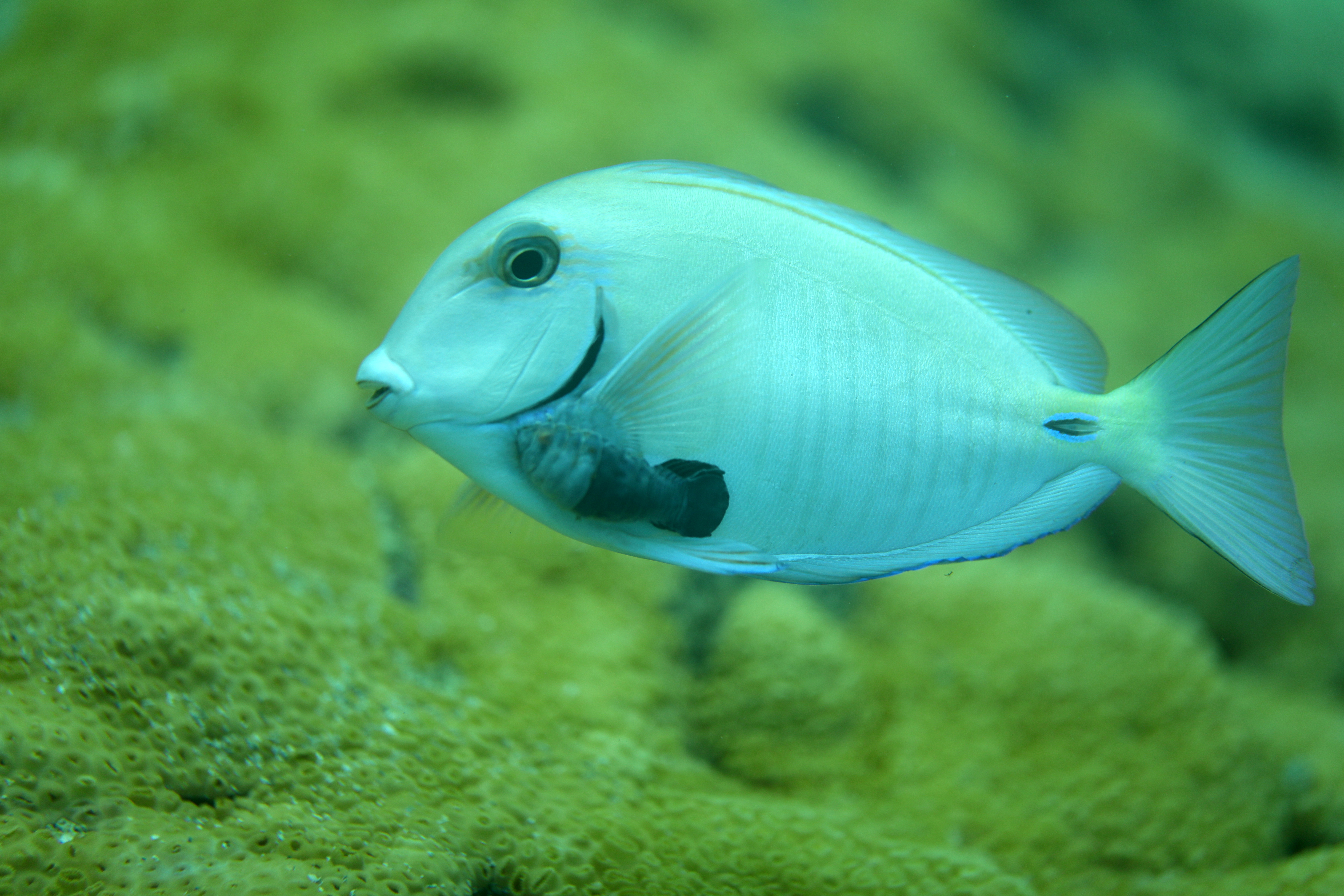
My last shots were of an Ocean Surgeonfish (Acanthurus bahianus) on which some Cymothoid Isopods had attached.

We swam West from the Wrap Around Ledge. Our Dive Time was 145 minutes at a maximum depth of 19.4 feet. My Actual Consumption was 19.26 psi/minute; my Surface Air Consumption was 13.24 psi/minute and the Residual Minute Volume was .34 cubic feet per Minute. 

When we surfaced I took a wave squarely in the face. My contacts popped out but Martha spotted and saved -12.0 contact for my left eye. She held my contact while I climbed out on the beach. I put my camera, weights and the tank down and went back to take Martha's fins and the flag. Should have taken her weights, too, but I didn't think  of it. Finally, I went back in the water and helped Martha climb out with her tank still on. I washed my contact out and got it back in my eye, so we loaded the Jeep and I drove us home.


05 September 2020

20200905_Fish Camp Rocks

Initial Phase Stoplight Parrotfish (Sparisoma vinde)
Because it was a holiday weekend, we headed to the beach at 6:30 am. As it was, the closest spot to my favorite spot at Tower 17 was 3 spots North, but people left and I got my spot around 7:30 am.  Louis or Leo arrived at 8:00 am and had to park South of the beach entrance. 


Initial Phase Stoplight Parrotfish (Sparisoma vinde)

A diver who parked North of me introduced himself and asked to walk out with us so the Life Guards would not hassle him for diving alone. He waited while Louis and Leo got ready and we all got in the water. I didn't want to hold him up and I was not sure that I wanted a hunter with us, so I suggested that he take off on his own while Martha and I waited for Louis and Leo. He did.

Intermediate  Gray Angelfish (Pomacanthus arcuatus)

Louis and Leo soon joined us and we swam out past the vessel exclusion buoy line and descended at 8:32 am on the blocks. I got this shot of a  Flamingo Tongue (Cyphoma gibbosum) as we headed due East to the Gray Mid-way Rock. We lined up and swam East up the gun sight, but I never saw the Cigar Rock.


Indeed, we got set to the North and ended up at the green mountainous coral head across from the Perpendicular Rocks. Along the way I got this picture of a French Grunt (Haemulon flavolineatum). 

We continued North past the Swept Rock and onto the Big Coral Knoll where we ran into the hunter who had walked out with us. He already had a couple of lobster. 


 We spent some time exploring the Knoll and I got some pictures of this well camouflaged Slender Filefish (Monacanthus tucken) 

 We  headed South to the Fish Camp Rocks and more green Mountainous Coral. 

I got this shot of some Glassy Sweeper (Pempheris Schomburgki) below.


On a smaller Green  Mountainous Coral nearby I also got this shot of a Juvenile Blue Tang (Acanthurus coeruleus). 

From the Fish Camp Rocks, Martha and I swam South to the Columnar Coral was covered with fine yellow cilia when I first saw it in 2007. Now it is just another rock. We swam back to the Fish Camp Rocks, to the Gray Mid-way Rock and then West to the beach.

On the flat but before the buoy line, I spotted a pair of Caribbean Reef Squid (Sepioteuthis sepioidea) who may have been mating. The larger one (male?) distracted me and the smaller one (female?) slipped off into some bushes. 

We headed West to the beach, but ended up well South of the lifeguard Tower.  

Dive time was 2 hours exactly at a maximum depth of  20.9 feet. My A/C was 23.70 psi/minute; SAC was 15.64 psi/minute and RMV was .40 cubic feet per minute.  


.


19 August 2020

20200819_Eastern Ledge off Tower 19

 Martha and I got up at 6:00 am and drove down to Tower 19 on the Fort Lauderdale beach. No on else was coming, so we geared up and swam out to the buoy line. We began our dive by descending at 7:31 am, swimming under the Vessel Exclusion Buoy and swimming East towards the ledge. 


We then swam East over some rubble and small rocks. About 24 minutes into the dive I found two Caribbean Reef Squid (Sepioteuthis sepiodea). They swam with us for several minutes. I followed and photographed them.


Shortly after the squids left, a large Gray Angelfish (Pomacanthus arcuatus) began to follow me. 


She was curious and I got the shot below of her about to bite one of my bubbles. 


We came to small patches of staghorn coral, but nothing like I remember from years ago when Nova University managed a project to grow staghorn corals to replant at other places on the beach. We came to the end of the reef about 45 minutes into the dive.


We swam down a 10 foot drop off to 32 feet and Martha quickly spotted a large Eyed Flounder (Bothus ocellatus). I took some pictures and we moved North along the bottom of the ledge. The Flounder remained still even when I got quite close. 

 At 55 minutes, we came back up on the top of the reef and headed West to the beach. We separated as we swam: Martha going North looking for shells and me holding a 270 degree bearing. 


We swam this way calmly for 34 minutes  when Martha suddenly grabbed me and pointed to a Spotted Eagle Ray (Aetobatus narinari) who was to the North of us but traveling East. I swam and took several pictures, though only three of them are useful. 


It took a while to settle down after chasing the ray, then I photographed the Smooth Trunkfish (Lactophrys triqueter) below. 


We surfaced inside the buoy line six minutes later and in 6 feet of water  Our Dive Time was 112 minutes at a maximum depth of 32.2 feet. My Actual Consumption was 25.05 psi/minute; my Surface Air Consumption was 15.90 psi/minute and the Residual Minute Volume was .41 cubic feet per minute. 


17 August 2020

20200817_Ledge at Tower 18


Martha and I drove to the beach at 7:30 am to meet with Chris, who came about 7:45 am. We first changed the o-ring in his tank, which reminded me that I need to replace the o-rings in several of my tanks. We talked about the dive yesterday and the importance of good buoyancy control. I got face to face with him and tried to get him to take a breath and rise in the water column, but he couldn't. 

We swam back to the beach and exchanged the 3 lb weights Chris carried for 2 lb weights which helped him control his buoyancy. We swam back out past the buoy line and descended at 8:02 am.

I then had him swim out to the Eastern Ledge on a 90 degree bearing and we swam with him, though I had to get him to slow down and focus on his buoyancy. He held the bearing well, but there were moments when his focus wandered.


Along the way, we swam with a small Green Sea Turtle (Chelonia mydas) who swam with us for 5 or 10 minutes. 


We also encountered several Spotted Goatfish (Pseudupeneus maculatus).


I got a shot of this  Ocean Surgeonfish (Acanthurus bahianus)


and this  Blue Angelfish (Holacanthus bermudensis). We were now 35 minutes into the dive and we went over the ledge and down to 34 feet. We swam North along the Ledge for a few minutes. Martha and I had short fill tanks, and were getting down to 1500 psi, so we used our buoyancy control to rise up onto the reef and head West towards the beach.


As we left the bottom I got this shot of a Bar Jack (Caranx ruber) who swam by just to see what we were doing.  


Above us in the water column was a small school of Ballyhoo (Hemiramphus brasiliensis). I took several shots, but I was shooting into the sun and most of the shots did not turn out well. 

We swam West and got inside the buoy line as we surfaced at 9:27 am and swam to the beach. 

Dive time was 85 minutes at a maximum depth of 34 feet. My Actual Consumption rate was 25.16 psi/minute; my Surface Air Consumption rate was 16.28 and the Residual Minute Volume was .42 cubic feet per minute.